
- - -
- hours mins seconds
to get your checks by
Wednesday, Nov. 18th
Get it tomorrow
AFTER HOUR ALERT
Ooops! You missed todays deadline.
Your order will ship the next business day.
Need checks sooner?
Select the Rush +$25.00 at checkout to receive them tomorrow.
* Submit your order before 5pm EST to enjoy this offer.

 0
You have no items in your shopping cart.
Final Paycheck Rules: Timing, Payouts and How the Check Gets Delivered
Last updated: November 16, 2026
Somebody has resigned, or has just been let go, and the question arrives within the hour. When does the last payment have to go out? The answer is almost never the one people expect, because the rule that decides it is not a federal one.
Quick Summary
Federal law does not force an employer to hand over a final paycheck on the spot. Your state sets the deadline, and it often differs depending on whether the person quit or was discharged. Several states want the money the same day, which is why the final payment is so often written rather than deposited.
- No federal deadline exists, and the federal floor is the regular payday.
- State law decides, and some states require immediate payment.
- Quitting and being fired are treated differently in most states that regulate this.
- Vacation payout is a state and policy question, not a federal one.
- Holding the check over unreturned property is not generally allowed.
- Where the check must be available is a separate rule from when.
Four states show how wide the range is. These are illustrations, not a substitute for your own statute.
| State | Discharged | Quit |
|---|---|---|
| California | Due and payable immediately | Within 72 hours, or on the last day with 72 hours notice |
| Massachusetts | In full on the day of discharge | On the following regular pay day |
| Colorado | Immediately | On the next regular payday |
| Texas | By the sixth day after discharge | By the next regularly scheduled payday |
This is background on payroll practice rather than legal advice. Final pay is governed by your own state's wage law, and sometimes by your city, so your statute and your employment attorney are the authorities to rely on.
On the payment itself, payroll checks carry the stub a final payment needs, which is where the separate lines for wages and leave belong.
What this guide covers
- Does federal law set a deadline?
- How does quitting change the deadline?
- Do you have to pay out unused vacation?
- Can you hold the check until equipment comes back?
- Where must the final check be available?
- Why does a same day deadline usually mean a check?
- What should the final pay stub show?
Does federal law set a deadline?
No. The Department of Labor states plainly that employers are not required by federal law to give former employees their final paycheck immediately. The same page adds that some states may require immediate payment, which is where the real deadline comes from.
The federal floor sits further back than most people assume. Under the Fair Labor Standards Act, wages are due on the regular payday for the pay period they cover. Federal guidance also confirms the Act does not require a discharge notice, a reason, or immediate payment of final wages to terminated employees.
There is a second federal gap worth knowing. The Act does not provide wage payment or collection procedures, so a claim for wages promised above the federal minimum is a state law claim rather than a federal one.
Which states have no final pay statute at all?
A handful. The federal payday requirements table records some states as having no regulations or not specified, Alabama and Florida among them. In those states the deadline comes from your own agreement and your established pay practice instead.
That is not a license to delay. An employer with no statutory deadline still owes the wages, and an unexplained delay invites a claim under contract or under a general wage theory.
How does quitting change the deadline?
In most states that regulate final pay, a discharge triggers a faster clock than a resignation. California is the clearest example. Wages earned and unpaid at the time of discharge are due and payable immediately.
The quit side of the same statute works differently. An employee who leaves without giving notice is owed not later than 72 hours thereafter. One who gives at least 72 hours notice is entitled to the wages at the time of quitting.
Massachusetts draws the same line in simpler words. A discharged employee shall be paid in full on the day of discharge, and someone leaving employment shall be paid in full on the following regular pay day.
What happens if the deadline is missed?
Several states attach a penalty to willful lateness, and it is not a flat fine. California continues the employee's wages as a penalty, and the statute caps that at 30 days. A short administrative delay can therefore cost far more than the payment itself.
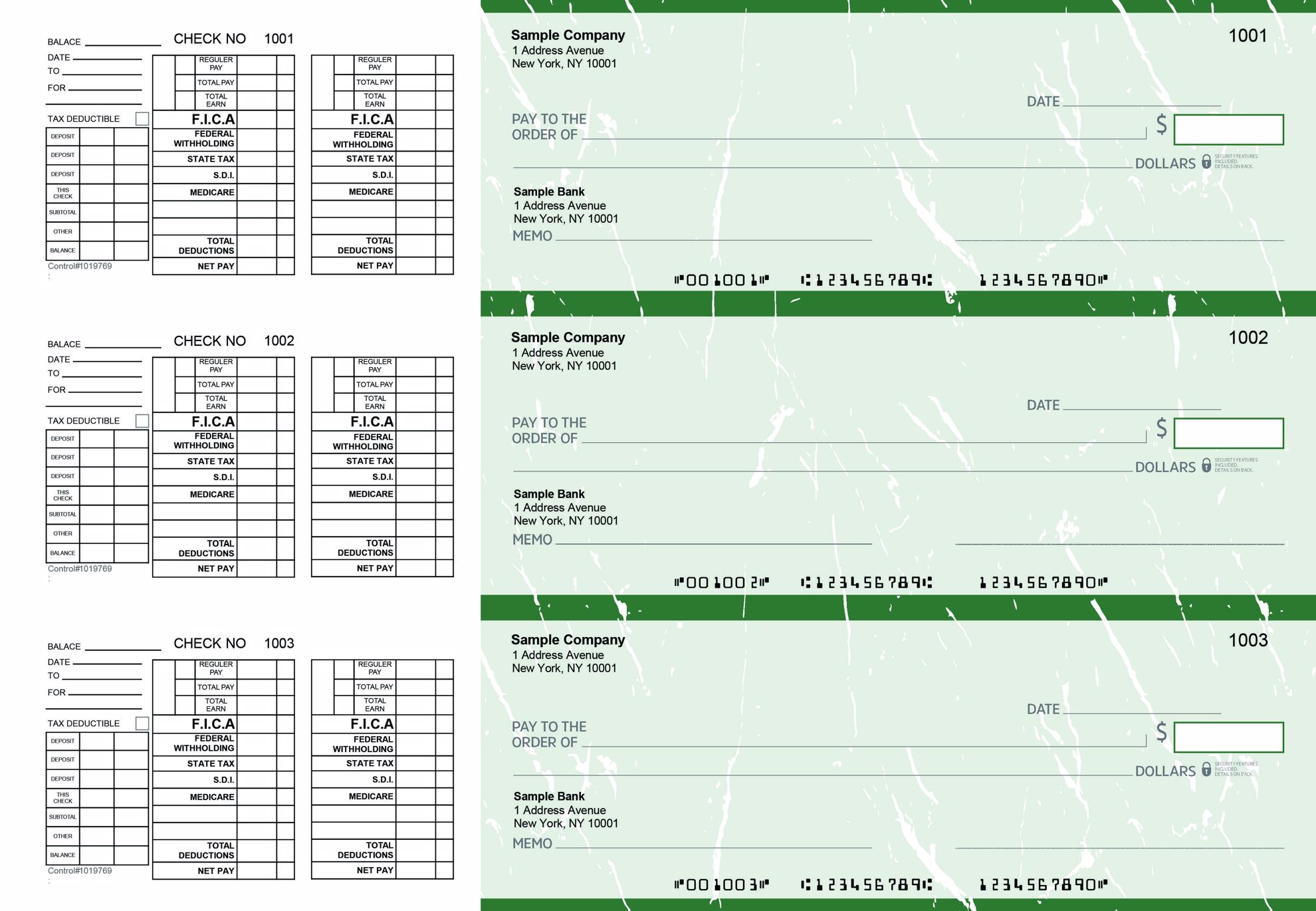
A final payment needs room on the stub for more lines than a normal week. See payroll business checks for that format.
Do you have to pay out unused vacation?
That depends on your state and on what your own policy promised. Federal law is silent. The Department of Labor notes the Act does not require payment for time not worked, such as vacations, so the duty has to come from somewhere else.
Where a state treats accrued leave as earned wages, the answer flips. California requires that all vested vacation shall be paid to the employee as wages at the final rate, and it does not allow a policy that provides for forfeiture of vested vacation time upon termination.
- Check whether your state treats leave as wages, because that single question decides it.
- Read your own written policy next, since it can create a duty the statute does not.
- Do not condition a payout on notice given without checking whether that is lawful where you are.
- Show the leave payout on its own line, so the figure is not mistaken for ordinary wages.
Negative balances need care. Where someone has taken more leave than they accrued, recovering it through a deduction raises the same questions as any other deduction from a final payment.
Can you hold the check until equipment comes back?
Generally no, and this is the single most common mistake in the whole subject. A laptop that has not come back is a property problem. It is not a reason to miss a wage deadline, and the two issues get resolved separately.
Texas puts it bluntly through its own labor agency, which states that it is not legal to hold a final paycheck past the deadline. That holds whether the hold is over equipment, an unsigned timesheet or a missing expense report.
There is a federal rule in the background too. Wages are not treated as paid unless they are paid finally and unconditionally, or free and clear, so an arrangement that routes value back to the employer's benefit can undo the payment.
What should you do instead?
- Pay on time, and treat the equipment as a separate conversation.
- Make returning easy, with a prepaid label or a scheduled drop off.
- Check your state's deduction rules before taking anything off the payment.
- Get written authorization only if your state allows it, because several do not.
- Keep the correspondence, since a wage claim will turn on what you can show.
Our guide to check signing policy covers writing the approval limits that keep a rushed final payment from going out unreviewed.
Where must the final check be available?
Almost nobody writes about this, and it causes more friction than the deadline does. The deadline tells you when. A separate rule tells you where the payment has to be and who may send it.
The pattern in states that address it is that the money must be available at the place of work or the place of discharge, and that mailing is an option the employee can choose rather than one the employer can impose. A policy requiring a former employee to come back and collect the payment in person can breach that.
- Have the payment ready where the separation happens, not at head office.
- Mail it only if the employee asks, and keep the request.
- Record the date it was made available, because that is the date you will be judged on.
- Never make collection conditional on signing anything.
When is the wage obligation actually satisfied?
Handing over an ordinary check does not settle the debt outright. Under the commercial code, taking an uncertified check suspends the obligation, and that suspension continues until dishonor of the check or until it is paid or certified.
That is a practical point, not a technicality. If a final payment bounces, the original wage obligation is still live, and the lateness clock is effectively still running.
Our guide to whether payroll checks can bounce covers what happens next when one does.
Why does a same day deadline usually mean a check?
Because a direct deposit cannot usually be originated and settled on the day somebody is walked out. A payment that has to exist by the end of the afternoon has to be something you can produce in the building, and that is normally a printed or handwritten item.
- Keep stock on hand for the account payroll runs from.
- Know who can sign when the usual signer is away.
- Hold a blank stub format that can show wages and leave separately.
- Record the item in the register the same day it is written.
- Keep a copy of the stub with the separation file.
Our guides to making payroll checks and how to write a business check by hand cover both routes, printed and written.
What should the final pay stub show?
More than a normal week, because a final payment usually bundles several things together. The person reading it has just left, so anything unexplained becomes a phone call or a claim.
| Line | Why it belongs there |
|---|---|
| Regular wages and the period | Shows the pay period actually closed out |
| Overtime, separately | Prevents a dispute about the rate used |
| Accrued leave paid out | Shows the payout was made and at what rate |
| Each deduction on its own line | A bundled deductions total invites a challenge |
| Net paid | Matches the item exactly, to the cent |

A check at the foot of the page leaves the most room above it. See business checks on the bottom for that layout.
What if the amount is genuinely disputed?
Pay what is not in dispute, on time, and keep arguing about the rest. Several states treat the undisputed portion as due regardless of the disagreement, and withholding everything while a single line is debated turns a small dispute into a wage claim.
Put the disputed item in writing, with your working, and send it with the payment. People accept a figure they can follow far more readily than a figure they are told to trust.
How do you pay the wages of an employee who has died?
Carefully, and not to whoever asks. Most states set out who may receive the final wages of a deceased employee, often a surviving spouse or a named beneficiary, and sometimes up to a stated amount without probate. Check that statute before writing anything, and keep the documentation you relied on.
Related reading
- Payroll checks covers what a wage payment must include.
- Check register covers recording an item written outside the normal run.
- Check signing policy covers who may approve an urgent payment.
- Can payroll checks bounce covers a final payment that fails to clear.
What to do next
Look up two things for your own state and write them on the separation checklist: the deadline for a discharge, and the deadline for a resignation. Those two dates are the whole compliance question, and almost nobody has them written down before they need them.
Then make sure you can actually produce a payment on the day. Payroll checks are printed with the stub space a final payment needs, and high security business checks suit an account that only gets used occasionally.
About the Author
Small employers order from us in a hurry more often than any other group, and the reason is nearly always the same. Someone has left, the state wants the money today, and the payroll service cannot move that fast. A box of stock in a locked drawer is the cheapest insurance against that afternoon.
The deadlines, penalties and leave rules above are drawn from federal wage guidance and from the labor codes of California, Massachusetts, Colorado and Texas. They appear here as worked examples, since every state writes its own. Yours decides what you actually have to do.